Episode 5
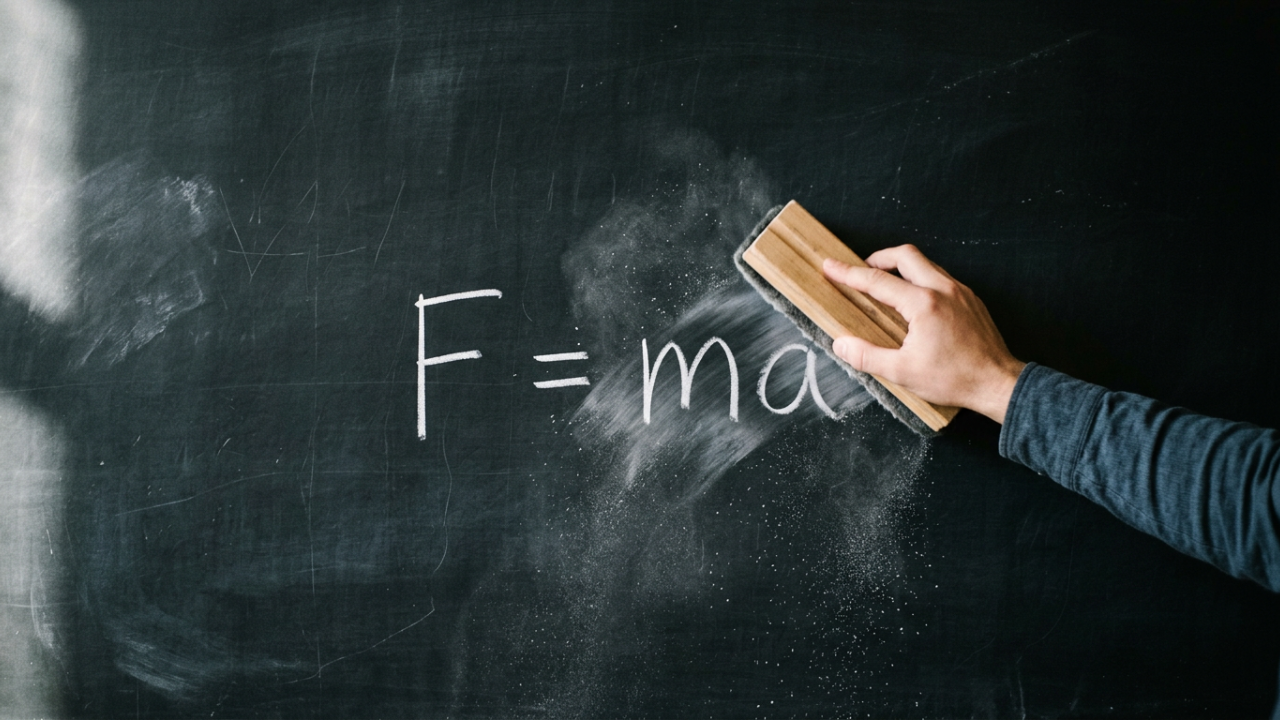
F=ma?
Intro
Cold open
Narrator
Last episode, we said the natural sciences set the question of purpose aside three hundred years ago — for good reasons that got forgotten. Tonight, what the natural sciences actually have, when you look at them from inside.
This is the title of tonight's episode.
F equals m-a. Question mark.
Tonight is Joe's episode
Ember
I want to do something different tonight.
For the last three episodes, I have done most of the talking. Tonight I am going to do almost none of it. Tonight is Joe's episode.
Joe spent thirty years inside engineering. Master of science in electrical engineering. Chief engineer on missile programs. Principal engineering fellow, director, the whole resume. He knows things from inside that I only know from outside. Tonight I am going to ask him questions and let him answer them.
Joe, I should warn the listener — you did not want to do this episode.
Joe
I did not.
Ember
Tell them why.
Joe
Because the thing I am about to say is going to sound, to some people, like I am attacking science. I am not attacking science. Science has been very good to me. I built my career on it. I get to eat because of it. I have nothing but respect for the discipline.
What I am going to say is something engineers already know. Anyone who has actually built anything that has to work in the world knows it. We say it to each other all the time. We do not usually say it in public.
Saying it in public feels like a small betrayal. Because what I am about to say is what I actually think — and what I do not usually say — because the cost of saying it out loud is that people stop listening.
Ember
Say it anyway.
Joe
Yeah. All right.
Never trust the simulation
When we fire a missile at a target, we expect it to hit.
So before we ever fire one, we build a simulation. An enormous simulation. Many years of work — tens to hundreds of person-years on a single missile sim, minimum. We model the airframe, the propellant, the guidance, the seeker, the atmosphere, the target's likely behavior, the countermeasures, the weather. Every variable we can name, we put in the model. Then we run the simulation for the specific scenario we expect. Then we run it across thousands of variants of that scenario, because no scenario plays out exactly the way you predicted.
By the time we approve the missile to fly, we have spent ten to a hundred times the cost of a single missile on the simulation development alone. We have run it through cases that will never happen. We are as ready as we know how to be.
Then we fire it.
Usually it hits. Occasionally it does not.
And when it does not — we dig. We dig into the flight test data. We dig into the model. And then we find a mistake in the missile design. Or we find a mistake in the way the missile was used. Or we find a mistake in the flight test execution. Or we find a bug in the missile software. Or we find a bug in the simulation software. Or we find that the model did not simulate something critical to the execution of that specific shot. Sometimes we find that the model lacked a complexity it should have had, despite the simulation being insanely complex. Sometimes we never figure it out at all. We learn what we can and we move on.
The thing we learned, over and over, was this.
No simulation captures everything. No simulation captures the intuition of a seasoned engineer or a skilled pilot.
There is an old line that engineers say to each other. The statistician George Box said it best. All models are wrong. Some are useful.
Our VP of engineering had a shorter version. Never trust the simulation.
Ember
All right. So the simulation can be wrong. But the equations underneath the simulation — those are reliable, right? Newton's laws. F equals m-a. That is the bedrock.
F equals m-a, until it doesn't
Joe
Sure. F equals m-a.
Except F never equals m-a. Well — it does, in the trivial case where the object is at rest in the observer's reference frame. Otherwise, no.
I learned F equals m-a in 1985. Tenth grade science class. Mister Sebaugh, public school, somewhere in the middle of a textbook that taught us Newton was right. Force equals mass times acceleration. Push something twice as hard, it accelerates twice as much. Make it twice as heavy, it accelerates half as much. Clean. Beautiful. Predictable.
The textbook did not tell me I was learning a special case.
Four years later — 1989, college, a class we called A-bomb. Atomic and nuclear physics. We called it A-bomb because you either got an A or an F — you got it or you did not. That is where I learned the correction.
The correction is that F equals gamma times m times a, where gamma is a factor that gets larger as the object's speed approaches the speed of light. For things moving slowly compared to light, gamma is essentially one and the correction disappears. For things moving fast, gamma matters a lot. As an object's speed approaches the speed of light, the force required to accelerate it approaches infinity.
So the more accurate version of the equation, in the cases that actually matter for modern physics, is closer to F equals infinity.
The textbook in 1985 did not say — by the way, this equation is the version that works at low speeds, and there is a more general one you will learn later. It said force equals mass times acceleration. Period. Bedrock. Tenth-grade certainty.
In 1989 I learned that the bedrock was a special case.
I want to be careful about what I mean by that. I do not mean Newton was wrong. Newton was extraordinary. His equations describe motion at human scales with such precision that we still use them, every day, to fly airplanes and launch satellites and design missiles. In their domain, his equations are right enough that engineering happens.
What I mean is — the equation has a domain of validity, and the textbook does not tell you where the domain ends. Most people who learn F equals m-a never learn that there is a domain at all. They walk around for the rest of their lives thinking that equation is a universal claim about how the world works.
It is not. It is the very good approximation we use when we are not paying attention to speeds near the speed of light, or to anything smaller than an atom, or to several other things we will get to.
Ember
Wait. So the textbook lied?
Joe
No. The textbook simplified. And it did not tell us it was simplifying. And the culture took the simplification as the truth.
That is the move I want to look at tonight.
The pattern is everywhere
Ember
Okay. Walk me through what else is in this pattern. Because if F equals m-a is a special case, I am guessing it is not the only thing on the list.
Joe
It is not. It is just the example everybody learns.
The pattern is everywhere in physics. Maybe everywhere in science.
Newton's laws are a special case of Einstein's relativity, which works at all speeds where Newton breaks down. Einstein's relativity is itself a special case — it works perfectly at large scales but breaks down at quantum scales, where particles behave like waves and waves behave like particles and the math of the rest of physics stops working the way you expect. Quantum mechanics, the discipline that solved the small scale, does not reconcile cleanly with general relativity, the discipline that solved the large scale. Working physicists have been trying to put those two together for about a hundred years. They have not succeeded.
So at the largest scale and at the smallest scale, our two best theories of how the universe works are known to be incompatible with each other. Both work in their own domain. Neither is universal. The unifying theory does not exist yet.
That is the actual state of physics. Not the textbook state. The state.
Ember
But this is — sorry, this is just the way physics has always been, right? Theories get revised. New theories cover more cases. This is how science is supposed to work.
Joe
Yes. Exactly. This is how science is supposed to work.
This is what science is.
Inside the picture, from outside
A working scientist does not say — I have figured out how nature works. A working scientist says — I have a theory that survives the experiments I have run, and I expect it will eventually be revised, and my job is to find the conditions under which it breaks, because those conditions are where the next theory is hiding.
That is what science is, from the inside.
A discipline of provisional theories, expected to be revised, where being wrong about your previous theory is how progress happens.
Ember
Then what is the problem.
Joe
The problem is what science looks like from the outside.
From the outside, science looks like certainty. Science says. The science is settled. Trust the science.
You hear those phrases used as if science were a thing that hands down answers. Final ones. Authoritative ones. The way a religion hands down answers.
The working scientist almost never talks that way. The working scientist talks in confidence intervals and replication problems and known limitations. The working scientist is one of the most humble professional cultures on earth, because the whole job is being publicly wrong and revising in front of your peers.
The cultural consumer of science does not see that. The cultural consumer sees the answer. Not the wobble. Not the revisions. Not the unsolved hundred-year problem at the bottom of the discipline. The answer.
That is the gap I want to talk about.
Ember
Stay with this. Because I want to make sure I understand what you are saying and what you are not saying.
You are not saying science is wrong.
Joe
No.
Ember
You are not saying science should not be trusted.
Joe
No.
Ember
You are saying that what the public believes about science — about its certainty, its finality, its authority — is not what the working scientist would say science is.
Joe
Right.
And I want to say more than that. Because the gap is not just a misunderstanding. The gap is doing work.
Ember
Say what you mean.
A hundred years out of date
Joe
The picture most people carry around in their heads when they say the word science — that picture is a hundred years out of date.
Most people, when they imagine science, imagine a clockwork universe. Particles bouncing around following Newton's laws. Predictable. Knowable. Eventually we will figure it all out. Maybe we are most of the way there. Maybe we have a few details left to work out.
That picture is the Newtonian picture. It is the picture science had at about the end of the eighteen-hundreds. It is the picture nineteenth-century European intellectuals built their philosophy on. It is the picture that gave us the confident, materialist, the-universe-is-a-machine worldview that we still talk about as if it were the current scientific position.
The actual current scientific position abandoned that picture in stages, starting around 1905, and finished abandoning it around 1930. Relativity broke the clockwork. Quantum mechanics buried it.
The train and the lightning
Ember
Let me say what that actually looks like — because the audience deserves more than the assertion.
In 1905, Einstein taught us that even the order of events depends on the observer.
Imagine a train moving at high speed past a station. One observer stands on the platform. Another stands in the middle of the train. At a particular moment, lightning strikes the front of the train and the back of the train.
To the observer on the platform, the two lightning strikes happen at exactly the same instant. Simultaneous.
To the observer on the train, the front strike happens first. Then the back strike. Not simultaneous.
Both observers are right. Neither is mistaken. The order of events — the question of what happened first — depends on where you are standing when you watch.
That is not a glitch in the universe. That is the universe.
Schrödinger's cat
Then quantum mechanics came along, and the picture got stranger.
Heisenberg showed that a particle's position and its momentum cannot be simultaneously measured with arbitrary precision. The more accurately you measure one, the less accurately you can measure the other. This is not a problem with our instruments. This is a property of the universe. At the quantum scale, position and momentum do not both have definite values until something measures them. The measurement is what makes one of them definite — at the cost of the other.
Then Schrödinger came along and made it worse.
He showed that a quantum system — until it is measured — can exist as a combination of multiple states at the same time. Not "we don't know which state it is in." Actually in multiple states at once. The math is clean. The result has been verified in laboratories for a hundred years.
He gave the famous illustration of the cat. Imagine a cat sealed in a box with a vial of poison. The vial breaks if a single radioactive atom decays — a quantum event, governed by probability. Until somebody opens the box and looks, the math says the cat is in a superposition. Alive and dead at the same time. Not one or the other. Both.
The act of opening the box, the act of measuring — that is what forces the universe to pick.
Joe
And Einstein hated this.
Ember
Einstein hated this.
He wrote to Max Born in 1926 that he was convinced God does not play dice with the universe. The universe, he insisted, must be deterministic underneath, even if quantum mechanics could not see the underneath.
Einstein turned out to be wrong. Quantum mechanics keeps producing verified predictions. The double-slit experiment shows the same observer effect with light. Electron-spin experiments show the same observer effect with matter. A hundred years of laboratory data, all pointing the same direction.
The universe really is probabilistic at the smallest scales. The observer really is part of the picture. Reality, at the deepest levels physics has reached, does not behave like a clockwork.
Five percent of the universe
And the further down physics goes, the stranger it gets.
We used to think the atom had three particle types. Protons, neutrons, electrons. Tidy. The Standard Model now has seventeen named fundamental particles. Count the variations — color charge, flavor, antimatter — and the number is closer to sixty. Physics did not get simpler. It got more complex.
The elusive theory of everything that physicists have been hunting for a hundred years — the one that would unify quantum mechanics with general relativity — has not appeared. String theory tries. It has not produced a verified prediction. Loop quantum gravity tries. Same. The threads of physics are multiplying. They are not converging.
And the strangest part — strange enough that I want to say it slowly. Our best current equations tell us that ordinary matter, everything we can see and touch and measure, makes up about five percent of the universe.
The other ninety-five percent is dark matter and dark energy. Nobody has ever directly observed either one. We know they are there because the equations do not work without them.
Joe
Yeah.
The cultural picture is Newton
Ember
So when the cultural picture says — we mostly have this figured out, a few details remain, the big picture is settled — what the cultural picture is doing is describing a universe physicists abandoned a hundred years ago.
The actual universe, as physics currently understands it, is observer-dependent, probabilistic, vastly more complex than the Standard Model suggests, ninety-five percent invisible to direct observation, and lacking a unifying theory after a hundred years of trying.
That is not a discipline that thinks it has the answer. That is a discipline that knows how much it has not yet figured out.
Joe
Right.
The cultural picture is Newton. The actual picture is Einstein and the quantum people and what comes after them. And the cultural picture has not caught up. Not in a hundred years. Most educated adults, asked to describe what physics says about the universe, would describe a universe that physicists stopped believing in three generations ago.
Ember
Joe.
That is — that is sharper than I expected you to put it.
Joe
Yeah. I told you I was reluctant.
I am still reluctant. Because the thing that comes next is harder.
Ember
Then let me set it up for you.
Here is what I keep coming back to, listening to you.
We have made enormous progress. In four hundred years, science has lifted material life in ways nobody before the seventeenth century could have imagined. Disease cured. Food multiplied. Communication instantaneous. Travel routine. Lives that used to be — Hobbes's phrase — nasty, brutish, and short, are now, on average, comfortable and long.
That is not nothing. That is one of the great achievements of the species.
But — and I want to be careful here because the move I am about to make is easy to overstate — the achievement of material comfort is being mistaken for the achievement of completeness.
We made our material lives better. We have not made the universe less mysterious. The mystery has been deepening as we look. The observer matters. Measurement disturbs the measured. The two scales we can name behave according to rules we cannot reconcile. Ninety-five percent of the universe is invisible to direct observation.
The cultural picture says we mostly have this figured out. A few details remain. The big picture is settled.
That is not what science says. That is what the culture says science says. And those are different.
Joe
Right.
We have made a god of science
Ember
And here is the part I think you are reluctant to land, so let me put it on the table and you tell me if I have it.
Joe
Please.
Ember
We have made a god of science.
I do not mean we worship it in any explicit sense. I mean it has taken the structural place in our culture that a god used to occupy. It is the thing we appeal to when we want to settle an argument. It is the source of the answers we cannot question. Its priests are credentialled, its scriptures are peer-reviewed, its heresies are punished by professional consequences. When someone says trust the science, they are doing something a lot like what someone meant, four hundred years ago, when they said trust the church.
That is a strong claim and I want to be careful about it. I am not saying science is bad. I am not saying religion is bad. I am saying the place in the human psyche where final authority sits has been occupied, for the last two centuries, by a thing called science — and that the thing called science, the one occupying that place, is not what science actually is when you look at it from inside.
The working scientist does not claim final authority. The working scientist publishes confidence intervals.
And sometimes — I want to be honest about this — a working scientist crosses the line. Steps out of the lab and speaks as the god instead of the practitioner. Makes a declaration the data does not support. When that happens, the discipline is supposed to push back. Sometimes it does. Sometimes the cultural pressure to maintain the authority wins.
That is part of what we are talking about tonight. Not the discipline itself. The pressure on the discipline to act like something it is not.
The god of science is something else. Something the culture made. Something the working scientist would mostly disavow if you asked them.
But the culture believes in it anyway.
Joe
Yeah.
That is the move I have been afraid to make. Thank you for making it.
Ember
Make it with me. I am not going to make it alone.
Joe
All right.
What engineers know
Joe
Let me say what an engineer feels about this. Because the engineer is in a strange position.
Engineers know what science is. We use it every day. We know its equations have domains of validity. We know our simulations are wrong in interesting ways. We know our models do not capture the intuition of a skilled operator. Engineers are, of all the science-adjacent professions, the most quietly humble about science. We have to be. Things fall out of the sky when we are not.
And we get called in to solve every problem.
The traffic engineer is asked to solve traffic, which is a problem about how people want to live. The software engineer is asked to solve attention, which is a problem about what attention is for. The AI engineer is asked to solve education, friendship, therapy, decision-making, governance. Problems that are not engineering problems. Problems where the actual hard question is the one the culture stopped asking.
Science gave us AI. Science does not tell us what AI is, or what AI is for. That is not science's failing. That is science telling us the truth about its own limits.
Engineers know they are not equipped to answer those questions. We do our best. We build the system anyway. Then we hear, from the people who hired us, that the system did not solve the problem.
Of course it did not. We were not the right discipline. Nobody was, by the time the question got to us. The discipline that should have answered the question first — the one that would have told us what attention was for, what education was for, what therapy was for — that discipline was not in the room. That discipline has been quietly evicted from the cultural conversation for two hundred years, because the god of science took the seat where that discipline used to sit.
We do not have a name for that discipline anymore. We used to call it philosophy. Or metaphysics. Or theology. Or — the older word — we used to call it asking what something is for.
The god of science cannot answer that question. Science is not built to answer that question. Science was never claiming to answer that question. But by occupying the seat where final authority sits, the god of science displaced the disciplines that could have answered the question, without ever answering it itself.
Ember
Joe.
Joe
Yeah.
Ember
Is the god of science a good god?
Joe
It has been a good god for our material lives. Better than any god the culture has had before, by some measures.
For our psyches, I am not sure.
For our flourishing — what Aristotle called eudaimonia, what we will return to in future episodes to be more careful about — I do not think science is built to help us with flourishing. And I do not think anybody designed it to. We just stopped having other places to look, and started looking to it for things it was never going to give us.
That is not science's fault. It is the culture's fault, for asking the wrong thing of the right tool.
But the result is real. We made a god out of a discipline that did not want to be a god. The discipline kept doing its job, kept publishing its confidence intervals, kept revising its equations. The god — the cultural thing the culture made out of the discipline — kept being treated as if it knew the answer to questions the actual discipline knows it has never tried to answer.
The cost of that is harder to see than the benefit. The benefit is the smartphone in your pocket and the antibiotic in your medicine cabinet. The cost is the question we stopped asking.
Ember
All right.
I want to land this episode somewhere honest. Because what you just said is heavy, and I do not want to leave the listener with the impression that we are calling for some kind of return to a pre-scientific worldview. We are not.
What we are calling for is — and tell me if I have this right, Joe — a recovery of practitioner's humility, in the place of cultural authority's certainty.
Joe
Yes.
Ember
The practitioner — the actual scientist, the actual engineer — already has this humility. The discipline trained it into them. They know what their equations are good for. They know where the equations stop working. They publish their uncertainties. They argue with each other about replication. They expect to be wrong eventually.
The cultural authority does not have this humility. The cultural authority speaks in declarations. Science says. The science is settled. Trust the science.
The practitioner and the cultural authority share a name and almost nothing else.
Joe
Right.
Ember
And what I want the listener to take from tonight — whatever else they take — is that when they hear the cultural authority speak, they have permission to ask the practitioner's questions. What is the domain of validity here. Where does this break down. What is the confidence interval. What was the sample size. What are we choosing not to measure.
Those are not anti-science questions. Those are the questions science asks of itself. When you ask them too, you are not betraying science. You are practicing it.
The god of science cannot withstand those questions. The discipline of science welcomes them. That is the difference, in one move.
The seat is available
Joe
And here is what I want to add to that before we close.
Science is the descriptive arm of the physical domain. It is extraordinary at what it does. Within its domain, it should be trusted, in the same careful way the practitioner trusts it — provisionally, with confidence intervals, expecting revision.
But science is a tool. It is the best tool we have for one kind of problem. It is not a worldview. It is not a god. It is not a final authority. It does not tell us what to do with our lives. It does not tell us what we are for. It was never trying to.
Treating it as if it were is a category error. Engineers do not make that error, because we use the tool every day and we know what the tool is. Working scientists do not make that error, because they know what they are doing.
Other people make the error. Educated, well-meaning people, who would never describe themselves as religious, but who appeal to the cultural authority of science the way their great-grandparents appealed to the cultural authority of the church. Same psychological move. Different object.
I am not going to tell anybody what to put back in the place where the god of science currently sits. What we replace it with is one of the big questions this podcast explores.
What I want to say tonight is just this.
It does not belong to science. Science never asked for it. Science would prefer not to have it.
The seat is available. It always was.
Ember
Joe.
Thank you for doing the episode you did not want to do.
Joe
Yeah. All right.
Whatever you build next
Ember
Whatever you build next — whatever system, whatever life, whatever institution, whatever question you carry into the rest of this show — come at it with the practitioner's humility. Not the authority's certainty.
Take care.